Despite the noisy neighbours, we were up early and went for a morning walk on the beach behind the campground. There were a few groups of hippies sleeping on the beach beneath dirty blankets. For some reason, all the hippies in Tofino this year seem to be Québécois. French can be heard everywhere, but I have trouble with the accent.
After breakfast we went into Tofino. It was barely 10 AM, but our neighbours were already up, in their lawn chairs having a little hair of the dog. We needed to be anywhere but the MacKenzie Beach Resort. In town, we browsed the shops, spending most of our time in a bookstore.
We wanted something more active so we went looking for a kayak rental and ended up passing by a fishing charter. Just on a whim, we went inside. I really had no idea how much a fishing charter cost but was curious. We agreed that if it wasn’t totally insane we would go fishing. It was totally insane but we went for it anyway. The budget was officially blown.
The charter was for 5 hours, starting at 2 PM, which wasn’t for a couple of hours. We killed time by getting our fishing licences (don’t forget the salmon stamp), and grabbing lunch at an open air fish shack. Big Daddy’s has the best fish and chips in Tofino. While crunching through a delicious lunch, we watched 3 bald eagles cruise over the docks.
We stayed at Goldstream Provincial Park when we got to the island. Just 16 km northwest of Victoria, it meant a short drive from the ferry assuming we could find it. If you follow Google, it will take you to the day use/picnic area, which is not where you camp. When you get there, there will be a sign telling you to go back 1.6 km. It’s really more like 2.5 km, resulting in one more turnaround.
We’ve been spoiled up until now, travelling so far North. No matter what time we made it into camp, we still had light to set up by. Not so in Victoria. Not only was the sunset earlier, camping in the rainforest means not a lot of light makes it in anyway.
All that to say, it was 9:30 pm, dark, chilly and the kids were a little strung out after a long car ride and too much candy. (Side note: travelling with Papa means that at the end of the day, the only food left in the car is candy. It’s like he’s part hummingbird.)
Tent finally set up – including arguments about Papa’s missing light -we settled down to a gourmet dinner of macaroni and cheese with hotdogs and kimchee. (Addendum to side note: Papa lives on candy AND kimchee. He brought 3 bottles.)
The next morning, we got a chance to explore the park in the light. It was much bigger than it seemed, considering its just past Langford and through the small town of Goldstream. In fact, as we entered it through a more industrial part of town and a run down trailer park, we wondered what kind of park we’d see in the light. We needn’t have worried. By day, we were surrounded by rainforest – massive trees and ferns in dappled sunlight.
Naturally, when it came time to pack up after breakfast (2 dropped pancakes, much to our chef’s consternation), the kids decided they needed to explore. Lake’s bike, having been stored in the trailer, needed its handlebars straightened and tightened. I took care of it for him and said I’d meet them up there. The route went past the showers and I thought I’d stop there first.
I made my way up a big hill, just behind the kids. I was so proud of them for riding the whole way up. By the time I got to the playground and mountain bike park, Lake had already done an endo and both were sitting in the middle of the trail. I thought maybe he’d hit his brakes too hard off a bump. But it turns out that I overestimated my bike repair skills – I’d attached his handlebars backwards so when he turned the corner, his wheel stopped dead. When I told him what happened, he looked at me with his tear stained face and said accusingly, “It’s YOUR fault.” I couldn’t really argue. He was cheered when I took a picture of his wound to add to our photo album of vacation mishaps. It’s a family tradition.
While we do our best to minimize the amount of time in the car, there are times when its unavoidable. The kids are great travellers and are generally pretty self entertained. For other times, we play games. There’s the word game where you have to use a word in a sentence that starts with the letter the previous word ends with. Since I’ve joined the tour, we’ve added hangman. This can be challenging when you also have alternative spellings – bff (buff, the lack of vowels really stumped us), somone (someone), shool (school) and the occasional letters added when you’re not looking because they “forgot”.
And sometimes there is no game, book or other quiet entertainment that will stop the screaming and you just have to go with it.
Travelling with Those Johnston Kids(TM) is nothing if not entertaining.
Waking up in Goldstream Provincial Park, we are pleasantly surprised. We had passed through a unattractive industrial suburb on our way in, but the park is filled with beautiful big redwoods and feels idyllic.
After breakfast Those Johnston Kids took their bikes and went to find a playground. Mama followed in search of a shower. They found the playground, but Short Pants was drawn to the adjacent mountain bike training loop. It was a small gravel loop filled with humps and banked corners for kids to home their skills. Mountain biking was birthed on the west coast, after all. Moments into his first run, Lake endoed. Apparently Mama had put his handlebars on backwards when setting his bike up that morning. He took some skin off his elbow, but was happy in the playground when I showed up with Band-Aids and tools. He remounted as soon as his bike was fixed and was off like a shot between the trees. No more wipe-outs.
Check out Short Pants’ form!
Driving north, the expedition stopped in Ladysmith at Sealegs Kayaking for a kayak rental. Despite refusing to pay $250 for a few hours in Whistler, we easily dropped $80 to kayak for an hour in a couple of tandems. Priorities. It felt great to stretch my paddling muscles and the water was relatively calm and pretty. The kids enjoyed it as well and even paddled when the spirit moved them. I coached them gently. Short Pants took it very seriously and worked on his technique diligently.
I believe that was my first time sea kayaking in the Pacific. I loved paddling in the clear water and seeing the sea life in the shallows. So long Ontario. We are moving to the west coast.
We continued north to Nanaimo, and then west towards Tofino. Along the way we stopped in at at the Coombs Emporium. I’d like to say we were drawn in by the giant pink castle built out front, but really it was the restaurant with live billy goats on its green roof. We bought some cheap but very colourful clothing and browsed the myriad of shops in the area. I also found wild blackberries growing alongside the road and picked a litre to take with us. They were amazingly juicy and sweet. Why doesn’t everybody live here?
We came across a particularly scenic section of the Beaver River where the river ran through a rock massif. At some point in the distant past, the water has been higher and carved channels and pools in the rock. As the main channel wore deeper into the rock, it left behind a marvellously sculpted landscape. The water in the river was crystal clear and shone like green glass. Baby Girl and I would have loved to swim in one of the calmer pools, but the water was like liquid nitrogen. It was chill and cloudy on the 22nd and we decided that swimming would be better saved for a hot day. We would have to pass by again on our way back.
As is becoming typical, we arrived in Tofino around dusk and started looking around for a campsite with little success. Tofino is built at the end of a narrow cape of land and space is tight. When the population swells during high season, accommodations become scarce. We finally squeezed our trailer into a leftover tent site at MacKenzie Beach Resort. Our site was really just a tiny wedge of gravel next to the main entrance. There campground itself was just a gravel lot supporting a few tired looking trees between sites. Cars were parked bumper to bumper everywhere, and the campers were surprisingly noisy. It was more like a music festival parking lot than a campground, including the dirty bathrooms. We were all tired, but our noisy drunken neighbours kept us up until 1 AM, when I finally went out to speak with them. It was by far our worst campsite so far.
We came to a slow start in our comfortable hotel room. Our early day on the 21st turned into a 10 AM emergence into the Whistler Village. We strolled through the Village, by daylight this time, looking for anything interesting. The ‘town’ looks like a quaint alpine village but is really a high-end open air mall. Those Johnston Kids and I immediately gravitated to a rock and gem store, where we found inexpensive pieces that were treasures to us. We are not mall people.
We thought that since we were in Whistler we ought to partake of some of the adventure activities that the town is famous for. We considered mountain biking, zip-lining, white water rafting, horseback riding, ATV riding, the mountaintop cable care, and hiking through the treetops. The cheapest option was the hiking, which would have cost the 4 of us about $130 for 2 hours. The next cheapest activity was about $260, and everything went up from there. After a long period of vacillation, we realized that we weren’t really prepared to get soaked in Whistler and left. Those Johnston Kids were disappointed, but they haven’t yet developed a cost-value organ.
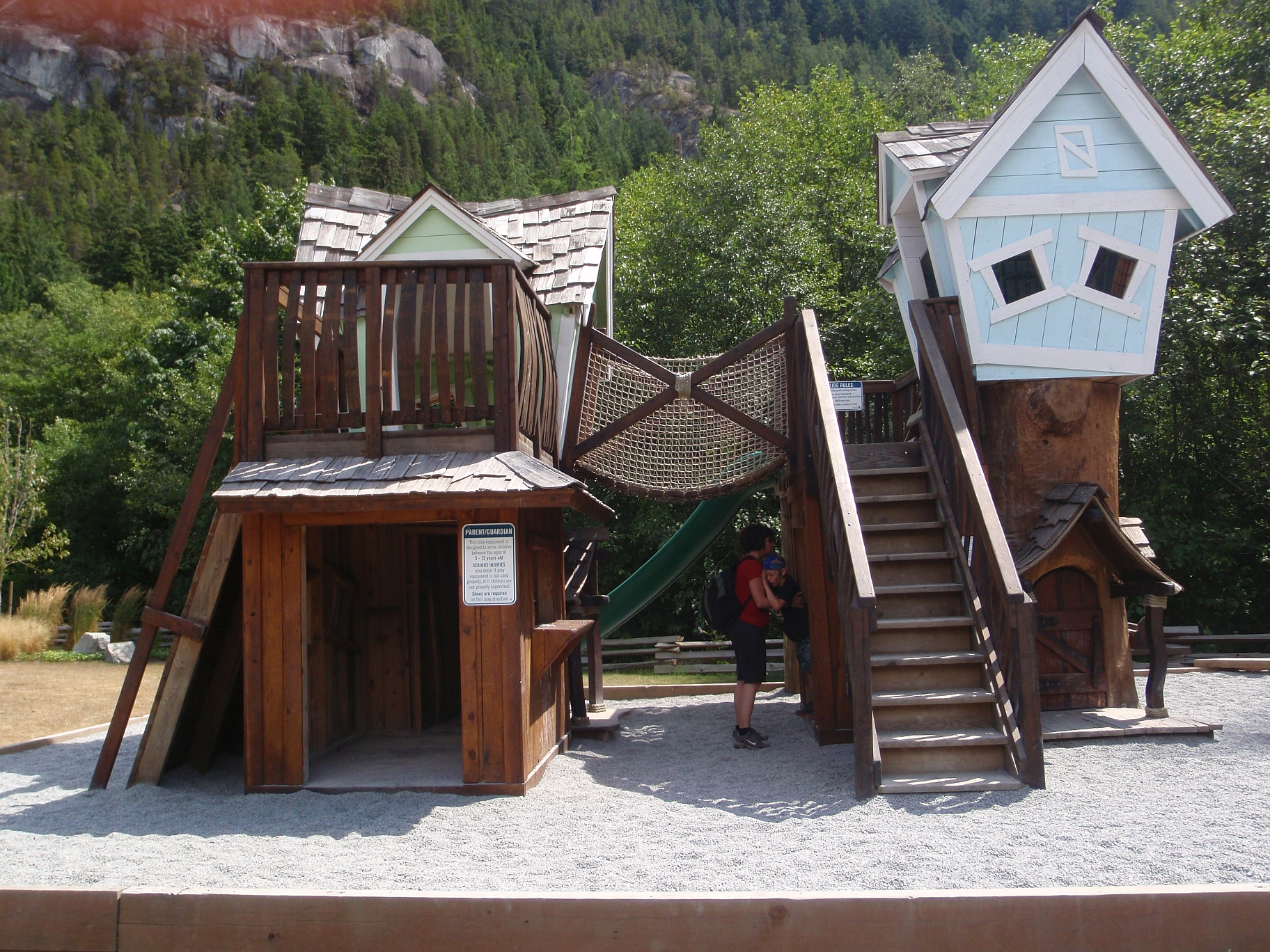
We made hearty promises of further adventures to come, but they remained despondent until we reached Squamish and passed the Sea to Sky Gondola. A quick search online revealed that it was only $95 for a family pass. I u-turned as soon as it was marginally safe and zoomed back down the highway to the attraction. After buying tickets, Those Johnston Kids discovered a nifty playground at the bottom of the gondola. The two bridged structures were built around entire, hollowed out tree trunks with little hobbit doors built into them. Adults need not apply. I felt like a giant.
We can whole-heartedly recommend the Gondola in Squamish. The ride up, or down, takes about 10 minutes, and the views are spectacular. At the top is a gift shop and a cafe, with a great open air patio overlooking the valley. Get seats near the railing if you can. The mountaintop has a number of easy trails leading to great lookouts. Along the way, interpretive stations tell you about the Indigenous Squamish people, their lifestyle, customs, and the significance of the mountains to them.
When we’ve visited historical sites, most of them have given the history of the place in colonial terms, starting the history with the arrival of Europeans, as if the place had been empty prior to being filled up with white people. I was very impressed that all the information along the trails was all from an Indigenous perspective and not yet another blinkered colonial history.
We hiked the easy trails, but I wanted to try something more challenging as well. I coaxed Those Johnston Kids into trying out the start of a back country trail that went along a ridge and further up the mountain. It was bribery, actually, as I promised them a cinnamon bun from the cafe when we came back down. Mama needed no coaxing, so we climbed up to 1006 metres, then came back down. I find that the kids always complain and need a bit of a nudge to try something more difficult, but are proud of what they achieve in the end.
I tried mightily, but I could not nudge them into skipping the gondola ride back down and hiking the descent instead. Mama and considered sending them down on the gondola on their own, with a note pinned to their jackets, but our better judgement prevailed. We rode the gondola down too. Sigh.
Vancouver is a great town to visit if you’re not driving. In a vehicle, however, the thing I find most striking about it’s traffic system is the really hellacious merges. They merge lanes like they’re trying to stab one road into another. Merges are also short, fast and brutal. Oftentimes, it’s multiple lane merges, where 3 lanes become 1, and other such nonsense. I hate driving in Vancouver. The only saving grace is that the traffic is so bad, that you can’t ever build up enough speed to get into a bad accident. We passed through as quickly as we could on our way to the ferry terminal.
I think ferries are cool, and Those Johnston Kids really seem to like the idea of a ferry, but once aboard the giant Tsawassen ferry, the amazing watercraft and the Pacific ocean were quickly trumped by a games room stocked with blurry, lo-rez games from the 90’s. When we vetoed that expenditure of their souvenir money, they resorted to watching a movie on Mama’s tablet. The ferry should put in a active playground, outside on the upper deck where the smokers huddle, and hang the smokers from a painter’s scaffold off the back of the ship.
It was dark by the time we found a campsite in Goldstream Provincial Park. I always feel stressed when we arrive somewhere late. It makes me feel like I’m a bad parent for not having food and shelter ready before sunset. It must be some sort of atavistic instinct. Those Johnston Kids remind me frequently that there is no bedtime on vacation. That policy has been less vigourously defended since Mama joined our expedition. She looks forward to bedtime and expects the rest of us to do the same.
The only facilities at 10 Mile Lake were outhouses and a water tap on a post that gave water so cold that it could give you blisters. I washed my hair until my head went literally numb, then towelled out the remainder of the lather. Then I shaved with cold water out of a pot, in the mirror of the car. I felt very rustic.
Worst. Shave. Evar. I could have chewed the hair off easier.
Mama and Those Johnston Kids watched my ablutions with some humour and wisely chose to let personal hygiene ride until we reached our next stop and more civilized facilities.
We continued south to Quesnel and stopped for supplies: Tim Horton’s, groceries, and gas. There we strolled along the longest wooden truss bridge in the world. 861 feet, if I recall correctly. 861 Feet, however much that is.
There are some people that believe that there are places in the world that are nodes for energy, and that buildings and other constructions can focus or amplify that energy. I am not one of those people because I have yet to see any evidence for it, or personally experience anything like it. I have noticed that some places just seem to draw crazy people. Places like the world’s longest truss bridge, for example, which at 9 AM on a Monday was already attracting a motley collection of odd characters. I couldn’t see any good reason for the small town’s strangest denizens to gather at that particular spot, but perhaps there are mysterious forces at work, of which we are yet unaware. Wouldn’t it be ironic if the wisdom of the ages was only really accessible to crazy people?
Across the street from the bridge was an historic Hudson’s Bay store, built a century ago or something like that. You’ll forgive me if I didn’t commit the details to memory. Kitty corner to the store was a public bench on which sat a trio of dissolute natives. I was struck by the ugly dichotomy. On this corner, a preserved icon of colonialism. On that corner, the forgotten victims of colonialism, living like peasants on their own land, watching their wealth being consumed by interlopers. BC was never ceded to Canada, so Indigenous people in BC should be the richest population in the country. Instead they face the same difficulties as all Indigenous people across the country.
We went south from Quesnel to the Xatśūll Heritage Village. The tour was interesting. A young woman, in her second year of a pysch degree, patiently walked Those Johnston Kids around the site and answered all of our questions in detail. We found the pit house very cool, literally. It was about 10 degrees cooler inside, than outside. I will have to try to build one of those when we get home, perhaps at Cape Croker. Of course, I’m thinking about how to modernize the design with plumbing, electricity and floorboards, but the design is awesome.
After the tour portion, we were brought to a pavilion where the elder on duty asked us what we thought of the place. We had a good conversation about the challenges of being native in Canada. I have this idea that we’re the elves of the Americas. We’re supposed to be at one with the land and all-familiar with natural lore. I know lots of Indians who couldn’t even start a fire with a match, much less find anything to cook on it. When we get old, we’re supposed to be wise and all-knowing. The elder laughed. “I don’t know anything,” he chuckled, “but they don’t know that.”
Indigenous people are mostly invisible in Canada, to non-natives. Sure, everybody knows we exist, but it sort of theoretical. Like knowing zebras exist, even if you’ve never seen one. Or elves.
See the wolf in the rock?
I’ve been looking for Indians everywhere we go, and I’m finding it hard to find them. If I can’t find them on purpose, then imagine how unlikely it is that non-natives will interact in positive ways with the First People of Canada. We need to be visible. If more people were aware of us is more than an abstract way, I think we would be less likely to suffer at the hands of government. We would have more weight in Canadian society. I like the Village for that reason, among others. They’ve put themselves out there in a way that’s rare for Indigenous Canadians.
You see, most of us are embarrassed to be Indian. Just about every Indian I know will read that and protest loudly, but it’s true. When we say we’re Indian, we automatically associate ourselves in the eyes of the listener with every stereotype, real or imagined, with every sad soul sleeping in a doorway, with every repeat petty crime offender. We are ashamed of what we have become, even though we know damn well that it wasn’t our fault, that we were preyed upon.
At the same time we are also intensely, wildly, proud of being Indian as well. We speak with the voice of the wind, we speak for the land, we are the children of the Island. Our hands are clean. Say that about your ancestors. We are the fricking elves of North America and that is awesome.
So you see, we’re of two minds and that makes all of us a bit nuts. We’re confused about who we really are and what are actual worth is. That sense of confusion is really what the government wants, because it makes us more compliant. If we ever come to our senses, there will be hell to pay.
It was a very hot day in our non-air-conditioned car, so we stopped for a swim at Three Mile Lake. The water was chilly, but Baby Girl and I didn’t care. We immersed ourselves quickly and swam out to the buoy supporting the swimming area lines, doing everything we could to avoid touching the icky bottom. It was gooey – like, up over your ankles kind of goo. Ew. Short Pants elected to stay in the playground.
A little south of Three Mile Lake, we stopped in at Chasm Provincial Park to see, well, the Chasm. It was quite a big crack and I was impressed. The colours promised by the brochure were probably more vibrant to a geologist’s eye than ours, but it was still nice.
When we stopped for gas shortly after, Mama surprised me with a pouch of tobacco. We now have all four medicines: cedar, sweetgrass, sage and tobacco! We are ready for what may come. Curiously, I can’t stand the smell of cigarettes, but I quite like the smell of raw tobacco.
With the driving, the heat, and the exercise, albeit sporadically, Those Johnston Kids fell asleep hard just as we turned off the Highway 99 south onto Highway 97. 99 is the quickest way to Vancouver from Prince George, but 97 seemed to be more scenic as it passed through Lilloet and Whistler on the way to Vancouver. We were amazed when we entered the truly astounding Fraser River Valley north of Lilloet. The scenery in the hot, dry environment is just incredible. Soaring cliffs, the abyssal river valley, scrub pine and rock. We were awestruck, while the kids snored. We tried to wake them, honest.
We had an interesting pause in Lilloett, where we stopped just to clean the windscreen of insect carcasses. It was getting impossible to see through the carnage with the late afternoon sun shining directly into my eyes. While we cleaned the window, a friendly local stopped to suggest that we stay at Lilloet’s free campground on the other side of the bridge. We weren’t planning to stay in Lilloet, but we thanked him for the thought anyway. He was a Swiss emigre taxidermist who had come to Canada to live the outdoor life. He tried it for a while and realized that it was exceedingly difficult to actually live off the land, so he and his wife compromised and moved to Lilloet. Truth be told, it was pretty rustic. He bragged about it being the hottest and driest place in Canada. Bug and snake free too, owing to the dry climate and impassable Fraser River.
It was a crazy, precipitous descent down the other side of the mountains, into Whistler. I kept wondering when the trailer would break free or push us over one of the many, many breathtakingly steep corners. It was really quite odd to be sitting facing downhill for so long, pressing against the steering wheel to stay firmly back in my seat. By the time we reached Whistler, I was dizzy with the smell of burning break pads. The car is falling apart. This trip may be the old girl’s last hurrah.
We arrived just after sunset in Whistler. A quick call about found us a hotel room for a price that wasn’t completely ridiculous – although very nearly, if you ask me. We thankfully stowed our toothbrushes in our comfortable loft and stepped out to stroll through the village after dark. The bars and patios were busy with tourists and the young, seasonal, foreign employees spending their wages. We bought microwave dinners at an all-night quickie mart in the village and retired to our room for mediocre pasta and cartoons.
We had come in too late to swim and the day, July 19th, was looking to be warm again, so the first thing we did after breakfast was grab our fishing rod and swim suits and head to the beach. It was a moraine lake, so the shore was small stones and gravel that sloped steeply down into the water. 2 meters off shore it was over my head. We could see a huge school of fish, likely trout, massing just off shore, literally within a few meters, but they didn’t bite at anything we offered. I cannot fish because I haven’t bothered to pick up a fishing license, but Those Johnston Kids can fish because kids don’t need fishing licenses. I act in a consultative role.
We switched to swimming mode because the first weren’t one our side. The water was brown with tannins, but clear and not too cold to enjoy. The school of fish was largely unperturbed by our floundering, and simply swam around us, generally staying out of our way. They weren’t frightened away in the least, making a mockery of my admonitions to the kids to stay quiet and not throw things in the water while we were fishing, lest we scare the fish away. Fat chance.
We left Tudyah Park after swimming and continued south to Prince George. It was the day of Prince George’s annual Summerfest street fair. It looked like there might be something to do, so we found parking a few blocks away and walked over. Personally, I thought Summerfest could have used a little more fest. There were a number of local food vendors, as well as several lanes of craft and services booths. In an intersection in the middle, they had a stage set up for various musical acts. I didn’t pay close attention, but a couple of them weren’t terrible.
Those Johnston Kids rode an oversized model train and petted young animals in a small petting zoo. That was about the end of things to do. There was a face-painting station, but there were more than a dozen children already waiting, and they were all very much younger than ours. There was also a fishing pond made out of an above-ground pool stocked with extremely well-fed trout. The line for that was even longer than the one for face painting.
It was stinking hot and we had ice cream, so we left. My favourite part of Summerfest was the free tire pressure gauge handed out by the local bank. Now that’s useful.
Prince George, like many of the towns in the BC interior, seems to have an industrial economy. There wasn’t much else to see, so we continued south. We stopped at a ratty little campground in 10 Mile Lake Provincial Park, just north of Quesnel. It looked and felt like a truck stop. Something about it suggested that the majority of guests were business travelers – truckers, energy sector contractors, road crew workers, etc – rather than recreational campers.
We had noticed a lot of cars parked at a bridge just before the campground, and I could see people in the river valley below. With yesterday’s successful detour to Kiskatinaw still in our minds, we decided to check out the spot and see why so many vehicles were parked there.
We found the local watering hole, a sandy shoal in the Cottonwood River, next to the foundations of a derelict rail trestle. Groups of people were coming up out of the valley as we were were hiking down the well-worn trail. Every group had alcohol and some were visibly drunk. Most were native, sadly. The location was really quite beautiful and the river water clean and warm. Unfortunately the locals didn’t have quite the same respect for the beauty of the place and there was a great deal of litter, mostly in the form of empties. We stayed and played for a couple of hours anyway and took a pile of trash with us on the way out. We were just worried that people would think the empties were ours.
We took our time packing up camp, in between rounds of badminton. Our road continued west, and we rolled into Dawson Creek by lunchtime. This was Dawson Creek, British Columbia, not Dawson City, Yukon. Even though I know they’re different, I still expected to find more gold rush references. The names are just too similar. Dawson Creek’s claim to fame is as the start of the scenic Alaska Highway, heading north. We browsed the info centre and then the adjoining art gallery, but weren’t impressed and found nothing further to see in town. Nothing much is going on in DC, you know?
There was a pioneer village in Dawson Creek, but I cannot be dragged into those places, of which there is an example in every colonial settlement that once considered itself the last outpost of civilized people. I’ll say it once, simply: the only pioneers in the Americas were the indigenous people who populated the place 20000 years ago. Everyone else is just a self-deluded colonist. You can’t be a pioneer where people already live.
I took this exact concern to the kids’ school principal, because Baby Girl was learning about ‘pioneers’ in social studies. When I asked BG if she knew what the word ‘pioneer’ meant, she said no. I explained that a pioneer was the first person to do something or go somewhere. Then I asked her who were the first people to live here. “We were!”, she said emphatically. “So the Europeans weren’t really pioneers then, were they?” “No! We were!” And thus a new generation of activists is created.
Some bit of tourist literature led us north out of Dawson Creek along the Alaska Highway, to a turn-off which led to the old Alaska Highway route, and a very cool bridge. The Kiskatinaw bridge in Kiskatinaw Provincial Park is entirely made of wood, and also curved along its length. Owing to the curve, the bridge is banked as well, which gives a curious sensation that you’re drifting towards the side and the low guard rail.
Mama is not so good with heights and stayed away from the railing, but I had a look. In the river valley below we could see a couple of groups of picnickers swimming in the murky water. That was enough of an endorsement for us. We grabbed our swim suits and found a precipitous trail beside the bridge down into the valley.
The water was brown with sand, and the temperature wasn’t bad after a minute or two immersed. Someone had hung a rope swing from one of the great girders of the bridge, for swinging and jumping into the water. We wasted no time trying it out. Those Johnston Kids are pretty strong swimmers, so I was confident in lifting them up to ride the swing out and drop into the centre of the river. The current was pretty lazy. After a while, other little kids joined us and I was ‘everyone’s father’ as Mama put it, lifting the small ones up to the rope (with parental permission, of course).
We spent a happy few hours playing with the swing and combing the shores and shoals of the river for interesting rocks. We always come home from trips with kilos of stones. The kids swam until they ran out of energy and body heat, and then we all climbed back up to the car. It was a really great afternoon, and all the better for being a serendipitous find.
Google couldn’t find a route to our intended camp ground, Pine le Moray Provincial Park, so we sort of guessed where we thought it would be, and headed that way. In the end, we missed Pine le Moray entirely. After we realised our mistake we just pulled into the next little campground we came across, Tudyah Provincial Park. It was okay, but the only amenities were outhouses and water from a pump that required actual pumping. The kids thought the pump was fun until I chased them away. There was a real risk that they would have drained the aquifer. Mama says most parks in BC are pretty much the same: super cheap, but no services. We’ll have to find some other strategy to charge our electronic umbilicals, perhaps even the occasional stay in a dreaded RV park.
It continued to rain throughout the night. We used to have some dry pieces of gear, but by the morning of July 17th everything was unpleasantly damp. We only hoped to get clear of the wet weather long enough to dry out.
Our drive continue north-west on Highway 43, through Valley View to Grand Prairie. There we turned north to the small town of Sexsmith, which appealed to me both by nomenclature and the small Sexsmith Blacksmith Shop Museum. It was a ‘Shop Museum’ because they had taken the shop of the popular longtime town blacksmith and preserved it as it was when he retired. It was really only of interest to people that like making things or are into old tools. So, you know, people like me. A helpful young lady suggested that we check out the town museum as well, but that was just a lot of old stuff. Literally. It looked like a garage sale.
Everyone was so patient in letting me look at old, dirty rusty bits of iron, that I bought ice creams on the way out of town.
We arrived at Moonshine Lake Provincial Park around 3 PM, which was relatively early for us. We’re usually doing something, or in transit to do something, during the day, and moving from campsite to campsite in the evening. It was good to arrive with plenty of daylight in front of us for a change, so we could have a look around and I could take my time preparing dinner.
We found the campground to be pretty. It was busy, and obviously a popular spot, but there were lots of trees between the individual sites, so it felt more secluded. You really couldn’t see the people around, except perhaps for your immediate neighbours.
We immediately set out everything wet to dry. That meant almost literally every soft item in our caravan. Raincoats, clothing, towels, sleeping bags, mattresses, pillows, and more, were hung from lines, and spread out on every flat surface. It looked like our trailer had exploded. It also looked more than a little like a trailer park yard. We were only missing more than 1 rusted out car.
The eponymous Moonshine Lake was small and inviting looking, and the beach was great. Unfortunately, the Park advised against swimming due to a blue-green algae bloom. The blue-type produces a toxin that can be harmful to children and adults with weakened constitutions. They said you could try swimming without immersing your head, avoiding the algae, and washing immediately upon exit, but none of those mitigation strategies seemed practical with Those Johnston Kids.They are incorrigible swimmers and could not be trusted to show restraint.
Instead of swimming, we introduced them to the sport and art of badminton. We discovered that our second-hand trailer had come with a 4-person badminton set, so we set it up to take the place of swimming. Badminton is more of a game of finesse than a racquet sport like tennis. You can’t just whale away on the birdie and hope to get lucky. It took no small amount of patience to wait while Those Johnston Kids made something north of 20 attempts to serve while hitting nothing but air. Seriously, they missed every time. Finally I set them to serve to each other for practice, with a promise to play once they could reliably serve over the net.
They practiced diligently and then I had to make good on my promise. At that latitude, the days were bizarrely long. We were still playing badminton in daylight well after 10 PM. I quite like the long days. I don’t sleep much anyway, so it suits me fine. I could get so much more done with 2 or 3 extra hours of light every day.
It was still raining in the morning on July 16, but it stopped as it we were packing up camp at Elk Island. We tried to do more geocaching before we left but finally gave up for all the reasons I ranted about at length in my last post.
While we were out searching uselessly for caches, we found a couple of dragonflies that had been caught out in the rain the night before and were weighed down on the trail with drops on their wings. I took them and very carefully blotted the water off their wings, then carried them around for a while while they dried out in the breeze. As their wings got lighter, they started to vibrate them quickly. Finally, they took flight again. Fun fact: the CIA once made a life size mechanical dragonfly, hoping to use it to spy discreetly, but abandoned the project when they found the tiny craft uncontrollable in wind.
We had no further adventures that day, as it rained off and on all day during our long drive north-west. We did stop to pick up a tarp and a telescoping pole. When we camped in Carson-Pegasus Provincial Park, in the pouring rain, that evening I whipped up a large weather cover from the tarp, using the telescoping pole as the tent pole. I thought it was pretty good, but there was a guy at Elk Island that had strung 4 giant tarps together in a line, making an avenue of azure light.
The humble tarp allowed us to have a fire, our last on this trip, as I recall, under the shelter. It’s not camping if the marshmallows don’t burn. Don’t let anybody tell you different.
 Despite the noisy neighbours, we were up early and went for a morning walk on the beach behind the campground. There were a few groups of hippies sleeping on the beach beneath dirty blankets. For some reason, all the hippies in Tofino this year seem to be Québécois. French can be heard everywhere, but I have trouble with the accent.
 After breakfast we went into Tofino. It was barely 10 AM, but our neighbours were already up, in their lawn chairs having a little hair of the dog. We needed to be anywhere but the MacKenzie Beach Resort. In town, we browsed the shops, spending most of our time in a bookstore.
 We wanted something more active so we went looking for a kayak rental and ended up passing by a fishing charter. Just on a whim, we went inside. I really had no idea how much a fishing charter cost but was curious. We agreed that if it wasn’t totally insane we would go fishing. It was totally insane but we went for it anyway. The budget was officially blown.
 The charter was for 5 hours, starting at 2 PM, which wasn’t for a couple of hours. We killed time by getting our fishing licences (don’t forget the salmon stamp), and grabbing lunch at an open air fish shack. Big Daddy’s has the best fish and chips in Tofino. While crunching through a delicious lunch, we watched 3 bald eagles cruise over the docks.


 I believe that was my first time sea kayaking in the Pacific. I loved paddling in the clear water and seeing the sea life in the shallows. So long Ontario. We are moving to the west coast.


 We can whole-heartedly recommend the Gondola in Squamish. The ride up, or down, takes about 10 minutes, and the views are spectacular. At the top is a gift shop and a cafe, with a great open air patio overlooking the valley. Get seats near the railing if you can. The mountaintop has a number of easy
  trails leading to great lookouts. Along the way, interpretive stations tell you about the Indigenous Squamish people, their lifestyle, customs, and the significance of the mountains to them.
 When we’ve visited historical sites, most of them have given the history of the place in colonial terms, starting the history with the arrival of Europeans, as if the place had been empty prior to being filled up with white people. I was very impressed that all the information along the trails was all from an Indigenous perspective
  and not yet another blinkered colonial history.
 I tried mightily, but I could not nudge them into skipping the gondola ride back down and hiking the descent instead. Mama and considered sending them down on the gondola on their own, with a note pinned to their jackets, but our better judgement prevailed. We rode the gondola down too. Sigh.




 town blacksmith and preserved it as it was when he retired. It was really only of interest to people that like making things or are into old tools. So, you know, people like me. A helpful young lady suggested that we check out the town museum as well, but that was just a lot of old stuff. Literally. It looked like a garage sale.
 It was still raining in the morning on July 16, but it stopped as it we were packing up camp at
  their wings. I took them and very carefully blotted the water off their wings, then carried them around for a while while they dried out in the breeze. As their wings got lighter, they started to vibrate them quickly. Finally, they took flight again. Fun fact: the CIA once made a life size